What Size Solar System Do I Need? A Toowoomba & Darling Downs Sizing Guide
Grab your last power bill. In five minutes you’ll know roughly what size system suits your home, farm or business, what inverter it needs, and how Ergon Energy’s rules affect it. Then let us confirm it on site, free.
Local Toowoomba team | SAA-accredited installs | Homes, farms & businesses | No obligation
Quick answer: how do I work out my solar system size?
Take the kWh usage from your power bill and divide it by the number of days in the billing period to get your daily usage. Divide that by 4.3 (the average daily output of 1kW of panels in Toowoomba) and you have a starting system size in kW. Then adjust for when you use power, whether you’re planning a battery or EV, your roof space, and your phase supply.
Example: a quarterly bill of 2,100kWh ÷ 91 days = 23kWh per day. 23 ÷ 4.3 = 5.3kW. Because panels produce less in winter and most homes add load over time, the practical pick is a 6.6kW system on a 5kW inverter.
Most Toowoomba homes land between 6.6kW and 13.3kW. Businesses and farms range from 30kW to 1MW, and systems over 100kW can now get the upfront federal rebate. See the 1MW commercial solar rebate.
Why Solar Sizing Matters More Than Price
Feed-in tariffs are a fraction of what you pay for grid power, so the money in solar comes from using your own solar power, not selling it. That changes how you should size a system.
Too small and you keep buying expensive grid power through the middle of the day, especially in summer when air-conditioning, pool pumps and irrigation are running.
Too big without a plan and much of your extra output gets exported for very little, or throttled by Ergon Energy’s export limits.
Right-sized means matching your panels to your daytime load, your roof and your connection, while leaving room for what’s coming next, like a battery, an EV or a new shed. That’s the system that pays for itself fastest.
Panels (kW) and inverter (kVA) are two different numbers. You can install up to 133% more panel capacity than your inverter rating and still claim the federal rebate, which is why a 6.6kW system usually runs on a 5kW inverter. Here’s how Excel Power designs systems.
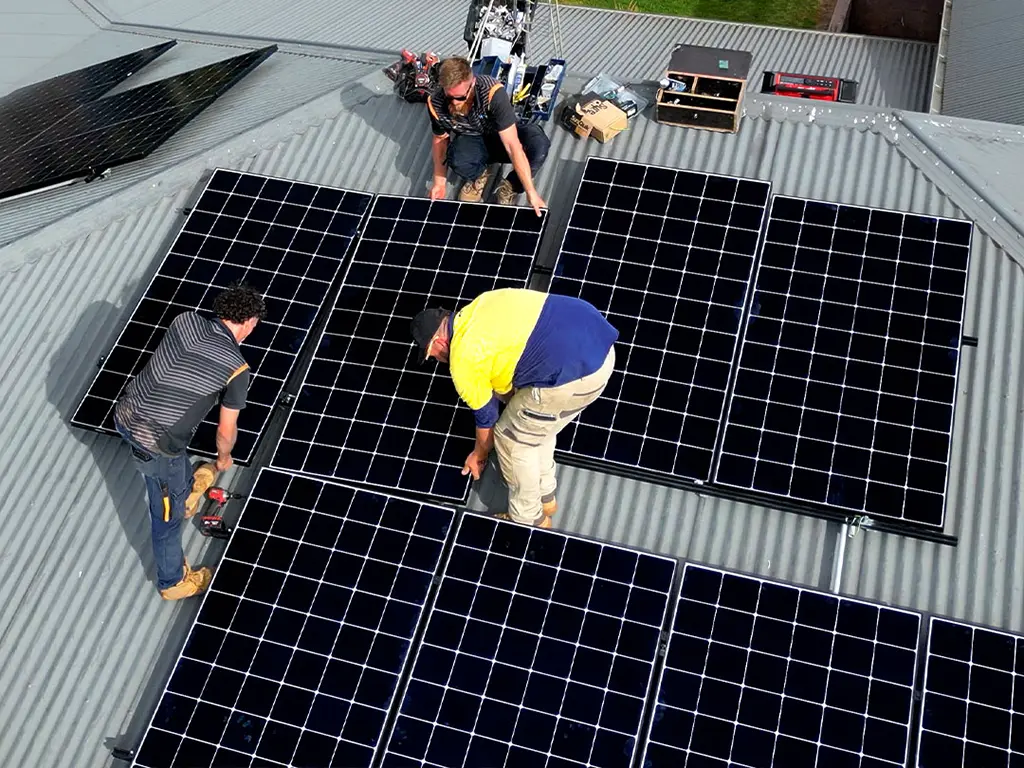
Guesswork Sizing vs Proper Sizing
Common sizing mistakes
✗ Picking a size because a neighbour has it
✗ Sizing on one summer bill (or one winter bill)
✗ Ignoring when you actually use power
✗ Forgetting Ergon Energy export and inverter limits
✗ No room left for a battery, EV or future load
How Excel Power sizes it
✓ 12 months of usage, not one bill
✓ Daytime vs night-time load from your interval data
✓ Roof space, direction and shading checked on site
✓ Designed to your phase supply and Ergon connection rules
✓ Future-ready for batteries, EVs and expansion
Solar System Size Chart: Find Your Row
Find your daily usage on your bill (total kWh ÷ days in the billing period), then find the closest row. These are starting points based on typical Toowoomba conditions; your roof, usage pattern and connection will fine-tune the result.
| Daily usage | Typical property | Suggested panels | Typical inverter |
|---|---|---|---|
| 10–15kWh | 1–2 people, gas cooking or hot water | 5–6.6kW | 5kW |
| 15–25kWh | Family home, split-system air-con | 6.6–10kW | 5–8kW |
| 25–40kWh | Larger home, ducted air-con, pool, EV | 10–13.3kW | 8–10kW (single-phase max 10kVA) |
| 40–100kWh | Acreage, home business, small farm, workshop (usually three-phase) | 13.3–30kW | 10–25kW three-phase |
| 100–400kWh | Retail, office, cold room, irrigation, poultry shed | 30–100kW | Commercial three-phase |
| 400kWh+ | Factory, warehouse, processing, large farm | 100kW–1MW | Custom design, now eligible for the upfront rebate |
Why the suggestions run a bit bigger than the maths? Panels produce less in winter and on cloudy days, and most households add load over time. A modest buffer keeps your bills down year-round and makes adding a battery later worthwhile.
The 5 Things That Decide Your System Size
1. How much power you use. Your bill shows total kWh. Use a full year if you can, because Darling Downs usage swings a lot between summer cooling and winter heating.
2. When you use it. If someone’s home during the day, or your business runs 9 to 5, you’ll use more solar directly and can justify a bigger system. If most of your use is in the evening, a battery may matter more than extra panels.
3. Your roof. A typical panel takes around 2m². North-facing is best, but east and west roofs work well and spread production across the day. Shade from trees or neighbouring buildings cuts output.
4. Your phase supply and Ergon Energy rules. On a fixed connection, Ergon generally limits exports to 5kW per phase. Single-phase homes can have up to 10kVA of solar inverter capacity, and three-phase opens up larger systems. We check which applies to your property.
5. What’s coming next. An EV, a battery, a pool, a new shed or a business expansion can all change the right answer. It’s cheaper to plan for it now than to add a second system later.
How Excel Power Gets Your Size Right
Usage review. We look at 12 months of bills and, where available, your smart meter interval data, so we can see exactly when you use power.
On-site roof check. We measure usable roof space, orientation and shading, and look at your switchboard and meter.
Connection check. We confirm your phase supply and design within Ergon Energy’s inverter and export rules, so there are no surprises at approval.
Options, not one number. You’ll see two or three sizes side by side with cost, estimated savings and payback, so you can choose what fits your budget.
Battery and EV ready. If a battery or EV is on your list, we’ll pick an inverter and layout that makes adding it easy.
One local team. From first visit to switch-on, you deal with the same Toowoomba-based team. For businesses and farms, see our commercial solar work.
From Power Bill to Perfect Size: 5 Steps
STEP 1 — Send us your bills. Book online and upload or email your last 12 months of power bills. Don’t have them all? One recent bill is enough to start.
STEP 2 — Free site visit. We check your roof, shading, switchboard and meter, and ask about your plans for batteries, EVs or expansion.
STEP 3 — Compare your options. You get two or three system sizes with price, rebate, estimated savings and payback side by side.
STEP 4 — Approval and install. We handle the Ergon Energy connection application, then our accredited team installs your system.
STEP 5 — Switch on and monitor. We set up your monitoring app so you can see exactly what your system produces and how much you’re using.
Solar Sizing FAQs
What size solar system do I need for my house?
Divide your daily usage (kWh from your bill ÷ days in the billing period) by about 4.3, the average daily output of 1kW of panels in Toowoomba. That gives a starting size in kW. Most Toowoomba homes end up between 6.6kW and 13.3kW once daytime usage, roof space and future plans are factored in.
How much power does a 6.6kW solar system produce in Toowoomba?
On average around 28kWh per day across the year for a well-oriented, unshaded system, more in summer and less in winter. Roof direction, tilt and shading all affect the real figure.
Is a 10kW or 13.3kW system worth it over 6.6kW?
It is if you use a lot of power during the day, run ducted air-conditioning or a pool, charge an EV at home, or plan to add a battery. If most of your usage is in the evening and you’re not planning a battery, the extra panels mostly export at a low feed-in rate, so a smaller system can pay back faster.
Why is my inverter smaller than my panel system?
Panels rarely produce their full rated output because of heat, dust and sun angle, so pairing them with a slightly smaller inverter is efficient. Federal rebate rules allow up to 133% of the inverter’s capacity in panels, which is why a 6.6kW system usually runs on a 5kW inverter and a 13.3kW system on a 10kW inverter.
What are Ergon Energy's solar limits for Toowoomba homes?
On a standard fixed connection, Ergon Energy generally limits solar exports to 5kW per phase. Single-phase homes can install up to 10kVA of solar inverter capacity, and a dynamic connection can allow extra battery inverter capacity. Three-phase properties can go bigger. The exact limits depend on your property and local network, and we confirm them as part of your approval.
How much roof space do I need?
Allow roughly 2m² per panel. A 6.6kW system usually needs 14 to 16 panels, or about 30 to 35m² of usable roof. A 13.3kW system needs about double that. Split arrays across east and west roofs work well if north-facing space is limited.
Should I size my solar for a battery?
If a battery is on your list, yes. A battery stores daytime surplus for the evening, so it needs a system big enough to cover your daytime use and still have enough left over to charge it. We’ll size the panels and inverter so a battery can be added easily now or later. Read our battery buying guide or check the federal battery rebate.
What size solar system does a business or farm need?
Start with weekday daytime usage, since that’s when solar is producing. Sites using 100 to 400kWh a day typically suit 30 to 100kW, while factories, cold stores and larger farms can go up to 1MW. Systems over 100kW can now get the upfront federal rebate. See our commercial solar rebate page for details.
Can I add more panels later?
Often, yes, but it can be more expensive and may need a new inverter or a fresh network approval. Planning a little extra capacity now, or choosing an inverter with room to grow, is usually cheaper.
Not Sure What Size You Need? We'll Work It Out for You
Send us a power bill and your address. Excel Power will check your roof and connection and show you two or three sizes side by side with cost, savings and payback. Free, no obligation, anywhere in Toowoomba and the Darling Downs.